
Testing & Growing Trials
We test, observe, and share what we learn.
John produces the castings behind Elmer’s Gold. Adam uses independent laboratory testing, microscope observations, and practical growing trials to understand the material and guide product decisions.
Below are reports for John’s castings, including the JS samples. They describe the samples tested on the dates shown, not guaranteed values for every bag. Natural batches vary. These are castings reports, not tests of finished S Brand Sprout Mix or BioBoost.
Read the laboratory reports
Microbial DNA — March 5, 2026
RhizeBio reported 2,147 bacterial species and 836 fungal species in the tested sample. DNA analysis helps describe the organisms represented in a sample; it does not establish that every organism is alive or active, or predict a gardening result.
Download the RhizeBio DNA report (PDF)
Humic and fulvic acids — February 17, 2026
Motzz Laboratory reported 11.57% humic acid and 2.69% hydrophobic fulvic acid using ISO 19822. These are the laboratory’s sample results; the report does not specify a dry-weight or as-received basis.
Download the Motzz humic and fulvic acid report (PDF)
Nutrients and moisture — August 8, 2025
Waypoint’s JS01 report covers nutrients, minerals, and moisture, with separate as-received and dry-basis columns. For example, the sample contained 49.1% moisture. This is one reason we sell by net weight but recommend measuring scoops when mixing into soil.
Download the Waypoint JS01 report (PDF)
Haney analysis — July 22, 2025
Regen Ag Lab’s JS02 report includes nutrient extracts, organic matter, pH, soluble salts, and respiration measurements. The sample measured pH 7.4, 28.1% organic matter by loss on ignition, and soluble salts of 4.41 mmho/cm. These describe the castings sample, not your finished soil blend; use the mixing directions for your product.
Download the Haney JS02 report (PDF)
Our day-46 tomato comparison
We compared three seed-starting approaches using red cherry tomatoes:
- Store-bought starting mix, watered with tap water.
- 75% starting mix plus 25% Elmer’s Gold, watered with reverse-osmosis water.
- 75% starting mix plus 25% S Brand Sprout Mix, watered with reverse-osmosis water.
Mixing percentages were measured by volume.
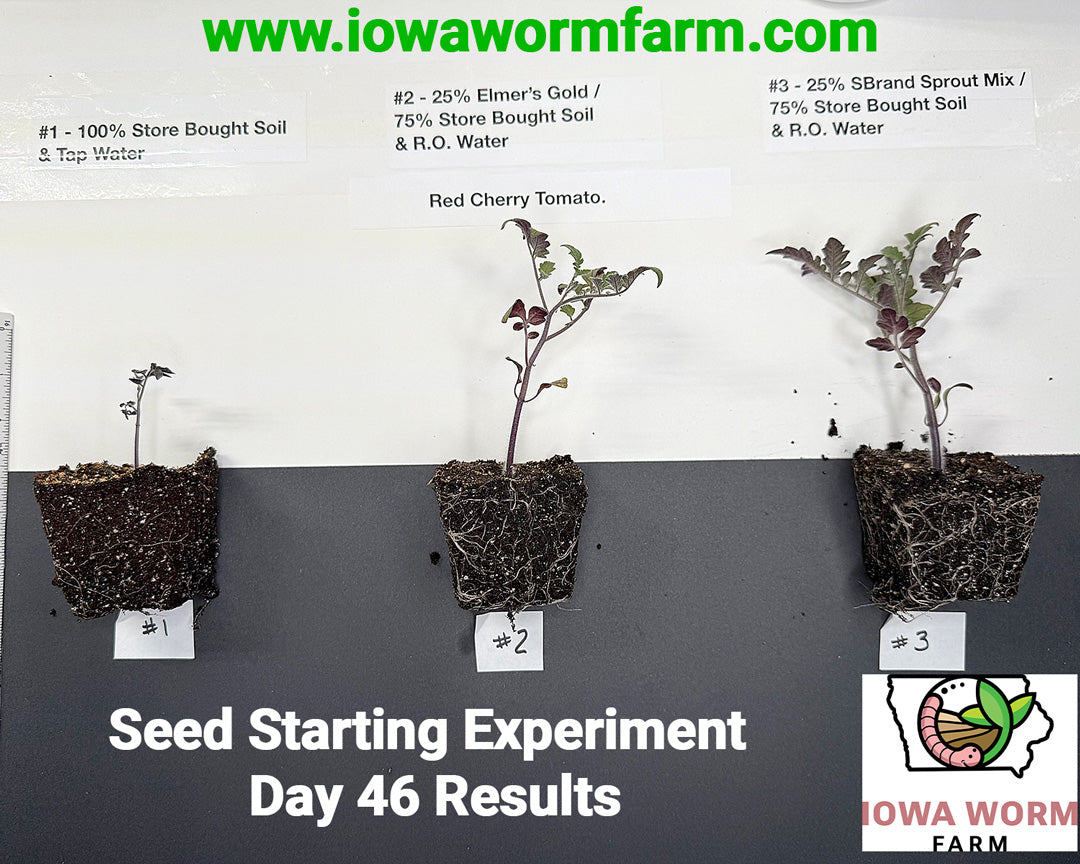
This practical comparison shows the results of those growing approaches. Because water source also changed, it does not isolate the amendments’ effects. Results vary with seeds, growing medium, and care.
Watch the full growing comparison on YouTube.
Put it to work in your garden
Shop Elmer’s Gold worm castings for everyday soil mixing and top-dressing, or explore S Brand Sprout Mix for seed starting. Questions about a report or your growing setup? Ask Adam.